
From the perspective of weapon replacement, consider commonly used analgesics.
- CosDream News

- Apr 23, 2024
- 3 min read
Updated: Jun 16, 2024
The human struggle against pain and the exploration of analgesic drugs have a long history.

From ancient civilizations where ancestors tasted hundreds of herbs, to Hoffman's acetylation of salicylic acid to the now famous aspirin.
Until today, patients no longer have to worry about the pain of surgery, as humans seem to have overcome the pain.
The three-step analgesic method recommended by the World Health Organization includes three categories: non opioid analgesics, weak opioid analgesics, and strong opioid analgesics.

Therefore, the author will compare commonly used analgesics to different levels of weapons, in order to better understand the potency of various analgesics.
1. Cold Weapon Era - Knives, Guns, Swords, and Halberds
Non steroidal anti-inflammatory drugs (NSAIDs) are an important milestone in the history of analgesics and are currently commonly used for the treatment of mild to moderate pain as well as remedial analgesia. Commonly seen include indomethacin, acetaminophen, ibuprofen, etc.
Non steroidal anti-inflammatory drugs have anti-inflammatory, antipyretic, and analgesic effects, such as ibuprofen, which has played a huge role in this epidemic. However, most non steroidal anti-inflammatory drugs have the potential risk of gastrointestinal bleeding, and professional physicians should be consulted before use.
2. The era of hot weapons - machine guns and artillery
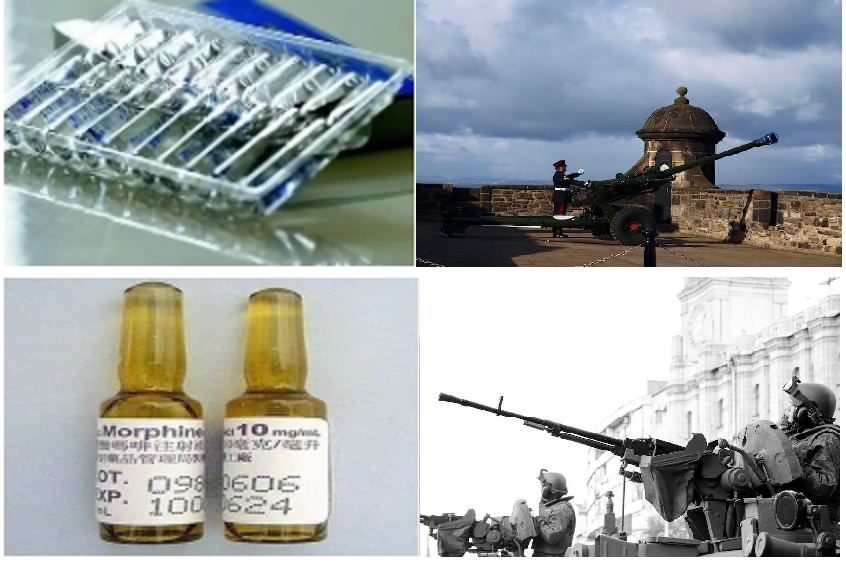
Opioid analgesics and weak opioid analgesics:
Tramadol: an artificially synthesized central analgesic drug with both weak opioid and non opioid mechanisms. Its analgesic effect is about 1/10 of that of morphine and is commonly used in cancer pain as well as acute and chronic pain.
Pethidine, also known as dolantin, has an analgesic effect of about 1/10-1/8 that of morphine. After use, it quickly develops tolerance and dependence, and is highly addictive.
3. Weapon of Great Powers - Missile Nuclear Weapons

Morphine: It has strong analgesic and sedative effects and is also a unit of measurement for the potency of opioid drugs. It is commonly used for acute severe pain, strong addiction, and many adverse reactions such as dizziness, respiratory depression, and vomiting.
Fentanyl: a potent opioid analgesic drug synthesized through modification of pethidine, with an analgesic intensity about 100 times that of morphine. It is currently commonly used as a general anesthetic, with generally similar adverse reactions to morphine, but less addictive than morphine.

Remifentanil: a new type of analgesic drug with advantages such as fast onset, short duration of action, and strong analgesic potency. Due to its unique metabolic mode, it does not accumulate in the body and wakes up quickly after discontinuation. It is commonly used for maintaining surgical anesthesia.
Sufentanil: an extremely potent opioid analgesic, with an analgesic intensity about 1000 times that of morphine and an analgesic duration about twice that of fentanyl.
Its adverse reactions are similar to those of fentanyl.

But it has the advantages of fast postoperative recovery, good hemodynamic stability, and reduced stress, and is suitable for surgical induction and maintenance of heart and large blood vessels. Currently, it is widely used in surgical anesthesia, postoperative analgesia, and ICU sedation.
Undoubtedly, analgesics are like weapons to soldiers to anesthesiologists. We should comprehensively grasp the pharmacological knowledge of these drugs, mix them reasonably, and achieve more comprehensive therapeutic effects.

At the same time, it is believed that with updates and upgrades, more new analgesic drugs will be introduced, with stronger efficacy and fewer side effects, creating a more comfortable medical experience for patients.





Comments