
After more than three years of setbacks, Argentina's procurement of a new generation of fighter jets has finally concluded with the official signing of an F-16 purchase contract with Denmark.
- CosDream News

- Jun 6, 2024
- 3 min read
After more than three years of setbacks, Argentina has finally completed the procurement of a new generation of fighter jets.

On May 26, Argentine Defense Minister Luis Petri officially signed an F-16 procurement contract with Denmark. Denmark will sell 24 retired F-16AMs to Argentina for $300 million.
This decision means that the Sino-Pakistani jointly developed JF-17 Block 3 has lost the opportunity to enter the Argentine market.
Compared to the nearly $200 million unit price of a brand new F-16V, these well-maintained F-16AMs, which have been in service for about 40 years, are expected to last another 15 years after refurbishment.
Selling them to Argentina for $300 million seems like a sincere offer.
The immediate delivery also meets the Argentine Air Force's urgent need for modern fighter jets, as it currently relies mainly on propeller-driven aircraft.
However, the $300 million is only the payment to Denmark.

Argentina will also need to pay the United States approximately $350 million for a comprehensive upgrade and to equip the F-16AMs with onboard weapons and train pilots to make them combat-ready.
In total, the average cost of these F-16AMs is about $27 million each, roughly half the price of the JF-17 Block 3.
However, the F-16AMs' lifespan is only half that of the JF-17 Block 3, which also has superior performance and upgrade potential.
From a technical perspective, the JF-17 Block 3 is actually a more suitable choice.
But after Argentina announced its consideration of purchasing the JF-17 Block 3, the United States expressed its disapproval and fully facilitated the F-16 deal.
Although Argentina initially engaged with China and Pakistan and visited the JF-17 production line, it ultimately focused its efforts on the F-16.
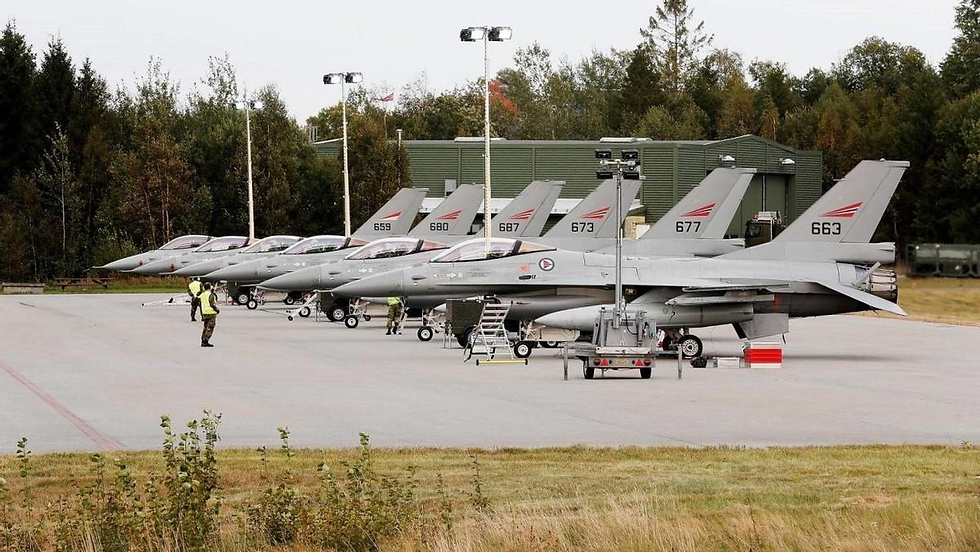
While Argentina lacks extensive experience in international military procurement, it is evident that it employed a strategy to benefit from competition between the two major players.
In the end, Argentina successfully acquired relatively advanced fighter jets with limited funds.
The U.S. prevented the Chinese JF-17 from entering the South American market and made a modest profit from the upgrade project. Denmark managed to sell its F-16s, which would otherwise have been scrapped, at a decent price, unlike the 19 F-16s donated to Ukraine without financial gain.
Although the UK has consistently opposed Argentina acquiring advanced fighter jets, in the choice between second-hand F-16s and the 3.5-generation JF-17 Block 3, the former was undoubtedly preferred.
Even if Argentina could potentially pose a threat to the Falkland Islands with these 24 F-16s in the future, the U.S. presence as a counterbalance ensures that all parties achieve their respective goals.

China and Pakistan may not have secured the order, but the loss is not significant.
The likelihood of Argentina purchasing the JF-17 Block 3 was always low. Despite the high expectations from public opinion, AVIC did not invest excessive resources.
The U.S., in its effort to ensure Argentina procured the F-16s, even accepted a reduction in Denmark's aid to Ukraine, underscoring the importance of this deal.
In military procurement, U.S.-made aircraft have a long service history in Argentina, and their operational mechanisms are most compatible with U.S.-made jets.
Coupled with the political and security assurances from the U.S., the F-16 was the initial best choice for Argentina, while the JF-17 Block 3 was merely an alternative.

A similar situation applies to Pakistan. Despite the induction of the J-10C, Pakistan still considered upgrading and expanding its F-16 fleet rather than directly purchasing the J-10CE.
Due to India's larger market, the U.S. consistently refused to provide Pakistan with F-16s, even prohibiting Pakistan from purchasing second-hand F-16s from Jordan.
Ultimately, under the pressure of India's acquisition of the Rafale F3, Pakistan procured the J-10CE.
After the delivery of the J-10CE, Pakistan's dependence on the F-16 gradually shifted to the J-10CE, which now holds a similar significance in Pakistan as the F-16 did a decade ago.
Once a breakthrough is achieved, military procurement tends to gain momentum rapidly.
China's weapons have established a stable market position in Pakistan, unlikely to face significant competition in the next 20 years.

This is the result of years of deeply cultivating the Pakistani market.
However, compared to the global reach of U.S. equipment, China's achievements appear relatively limited.
Although China's new weapons have significantly narrowed the gap with the U.S. in recent years, more efforts are needed to improve export performance.




Comments